Agent Tools
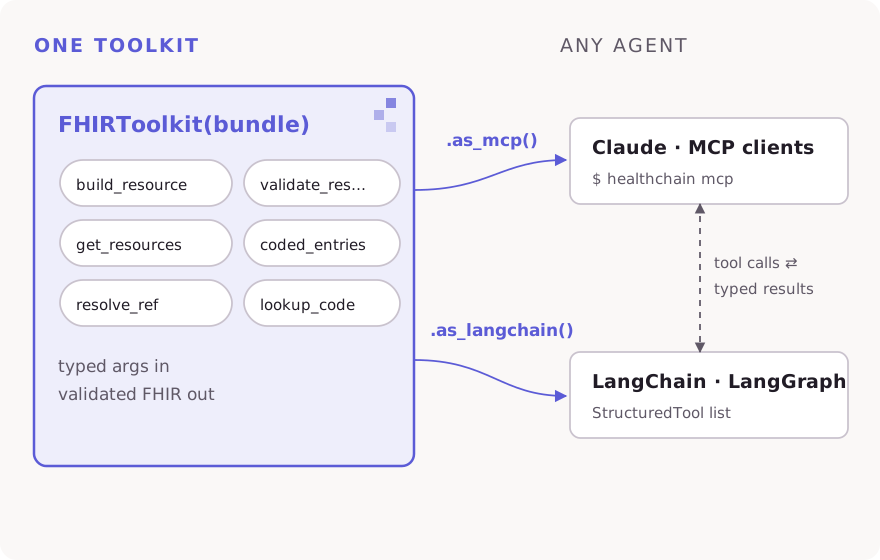
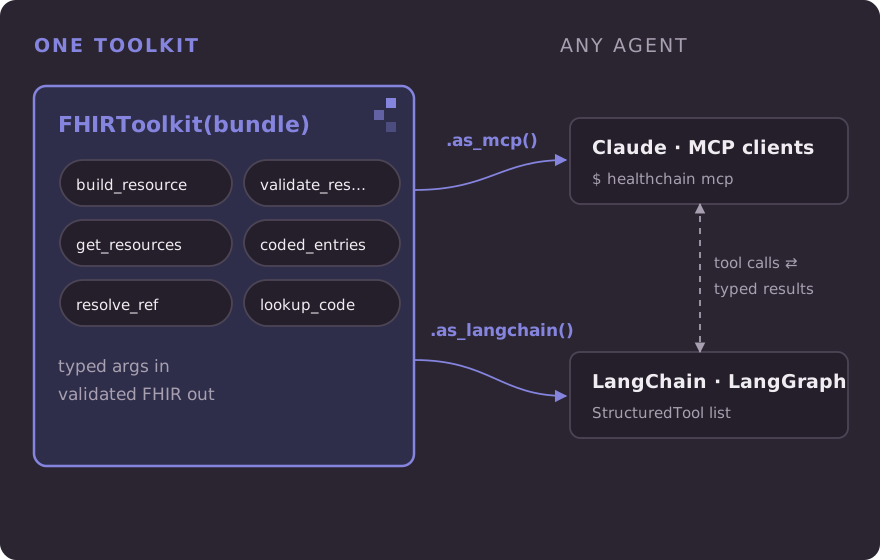
healthchain.tools packages the FHIR build/validate/read/lookup surface as agent tools: flat scalar schemas a model can fill reliably, JSON-safe returns, and errors as values a model can read and correct — a raised exception kills an agent loop; {"ok": false, "issues": [...]} is something it can fix.
Quick Start
from healthchain.tools import FHIRToolkit

kit = FHIRToolkit(bundle="synthea_patient.json")  # optional preload

kit.get_tools()      # framework-agnostic tools
kit.as_mcp().run()   # MCP server over stdio  (pip install healthchain[mcp])
kit.as_langchain()   # LangChain StructuredTools (healthchain[langchain])
Or from the command line — one line to register with an MCP client:
pip install healthchain[mcp]
healthchain mcp --bundle synthea_patient.json

# e.g. with Claude Code:
claude mcp add healthchain -- healthchain mcp
The tools
| Tool | What it does |
|---|---|
build_resource |
Build a FHIR resource from flat fields (Condition, MedicationStatement, Observation, AllergyIntolerance, Patient — including the dosage triplet dose_value/dose_unit/frequency_per_day), validate it, and return {ok, resource} or {ok: false, issues} |
validate_resource |
Validate any FHIR resource dict, required value-set bindings included — the read half of an agent's build→validate→correct loop |
load_bundle |
Load a bundle from a path or JSON string and make it the working bundle; invalid bundles return issues locating each problem |
get_resources |
Full FHIR JSON for every resource of a type in the loaded bundle |
get_coded_entries |
Flattened coded identity records (code/display/system/status/authored_on/value/unit), with medicationReference resolved |
resolve_reference |
Resolve Patient/123 / urn:uuid:... references; contained (#id) references take a parent_resource_id |
lookup_code |
Search the terminology catalog — so the model uses a returned code, never an invented one |
list_codes |
Browse the whole catalog. Only registered when the lookup is enumerable (LocalCodeLookup is; a remote terminology service isn't) |
The toolkit is stateful
FHIRToolkit holds one loaded bundle, validated once. Read tools operate on it instead of shuttling bundle JSON through tool arguments — which agents can't do at realistic bundle sizes, and which would re-validate on every call. Two ways to get data in:
# Host-injected (typical in a service: your app loads, the agent reads)
kit = FHIRToolkit(bundle=my_bundle)          # Bundle | dict | JSON | path
kit.bundle = other_bundle                     # swap at any time

# Agent-loaded: the model calls the load_bundle tool itself
Plug in a real terminology service behind the same protocol:
Hand-rolled tool-calling loops
No framework required — tool.spec is the plain {name, description, input_schema} dict tool-calling APIs expect, and run_tool dispatches by name:
kit = FHIRToolkit()
tools = [t.spec for t in kit.get_tools()]     # pass as your tools= parameter

# when the model returns a tool call:
result = kit.run_tool(call_name, call_input)  # dict or JSON-string arguments
Errors are values
Tools never raise. Missing bundle, unknown resource type, invalid codes, unresolvable references — all come back as {"ok": false, "error": ...} or {"ok": false, "issues": [...]} so the agent loop keeps control.